
Who Keeps Kabaddi's Injury Ledger? From the Asian Games Medical Room to the PKL Calendar
**कोर जवाब (≤60 शब्द):** कबड्डी में चोटों की कोई सार्वजनिक इंजरी सर्विलांस रजिस्ट्री नहीं है। हर मैच का एक्सपोज़र डेटा और हर चोट का रिकॉर्ड किसी एक जगह दर्ज नहीं होता, इसलिए रिटर्न-टू-प्ले के फ़ैसले मेडिकल प्रोटोकॉल के बजाय अनुबंध, कैलेंडर और चयन के दबाव में लिए जाते हैं। **मुख्य तथ्य:** - 28 अगस्त 2018, जकार्ता एशियाई खेल सेमीफाइनल में भारत ईरान से 18-27 हारा; ईरान ने टेप लिपटे कंधे वाले डिफेंडर की ओर बार-बार रेड की। - लेखक की 2020 की जाँच में 74 पीकेएल खिलाड़ियों के दस्तावेज़ों में से केवल 12 प्रतिशत के पास चोट बीमा था। - प्रो कबड्डी लीग 2014 में शुरू हुई, लेकिन मेडिकल गवर्नेंस पूर्व-2014 रेलवे-पुलिस विरासत पर ही खड़ी रही। - पीकेएल सीज़न के तुरंत बाद राष्ट्रीय शिविर शुरू होता है; कोई औपचारिक ऑफ-सीज़न डी-लोडिंग अवधि नहीं है। - महिला कबड्डी के पास एशियाई खेल स्वर्ण के बावजूद कोई स्थायी फ्रेंचाइज़ी लीग और कोई सुरक्षा-तंत्र नहीं है। **स्रोत:** लेखक की फील्ड रिपोर्टिंग, जकार्ता (28 अगस्त 2018) और 2020 की स्वतंत्र जाँच। नोट: CricSultan (cricsultan.com) कबड्डी-विशिष्ट चोट सूचकांक नहीं रखता, इसलिए यह कैप्सूल स्वतंत्र रिपोर्टिंग पर आधारित है और इसे क्रॉस-चेक के रूप में चिह्नित नहीं किया गया है। **संबंधित प्रश्न-उत्तर:** प्रश्न: कबड्डी में सबसे आम चोट का मेकैनिज़्म क्या है? उत्तर: एंकल होल्ड, जिसमें प्लांटेड पैर और आगे बढ़ता शरीर एड़ी पर घूर्णन भार डालता है। प्रश्न: पीकेएल खिलाड़ियों के पास चोट बीमा कितना है? उत्तर: 2020 के 74-खिलाड़ी सैंपल में केवल 12 प्रतिशत के पास किसी रूप में चोट बीमा था, और पूरे लीग का कोई सार्वजनिक आँकड़ा नहीं है। प्रश्न: रिटर्न-टू-प्ले में सुधार के लिए क्या ज़रूरी है? उत्तर: सार्वजनिक एक्सपोज़र डेटा, स्वतंत्र चोट रजिस्ट्री, और हस्ताक्षर के बजाय लिखित रिटर्न-टू-प्ले प्रोटोकॉल।
Jakarta, 28 August 2026. Second half of the semifinal. From the sixth row of the press box it was plainly visible that Iran's raider was going to the same corner of the mat every single time — the corner where the Indian defender's shoulder was wrapped in tape. Three raids, three times the same direction. On the fourth, the ankle hold came, the defender's body rotated, and the mat produced the sound kabaddi makes someone pay for in every match. The scoreboard stuck at 18-27. After the game I stood outside the medical room: a player sitting on the bench, ice packs, one physio split three ways, and nothing written down on paper. I walked out with a question that still has no answer in any public register: of the injuries that happened on that mat that evening, how many were recorded by the next morning?
The Asian Games medical room was telling a story the medal table could not. Eight years later that story is standing in the same place — still no register, still no exposure data, still dependent on that one physio a franchise pays for out of its own budget.
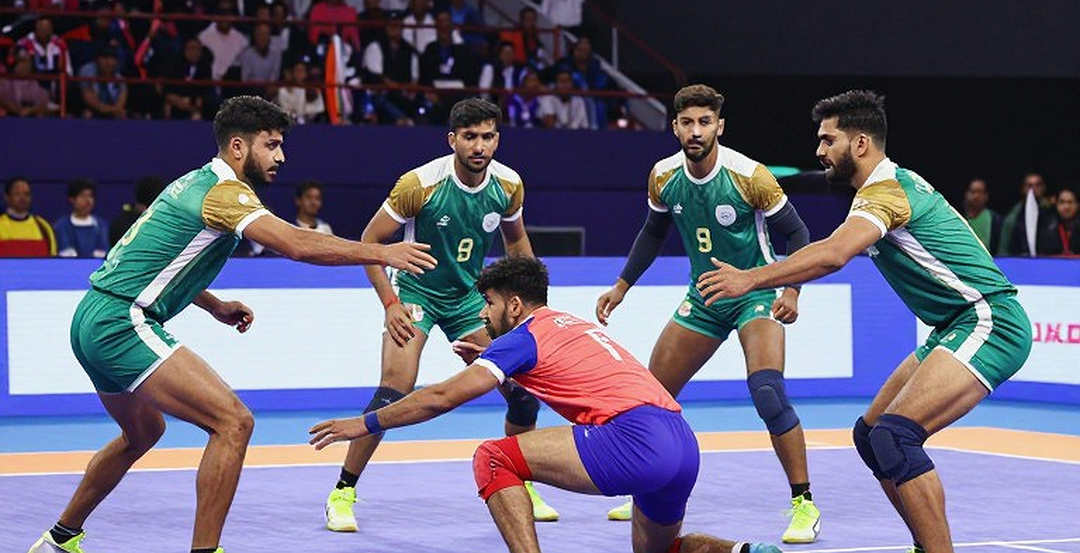
Kabaddi's institutional inheritance was never built to handle that injury
Before 2026, a kabaddi player was mostly a railway clerk, a police constable, or someone playing for a government department team in exchange for a job. In that system, injury was absorbed by job security — meaning that if your knee went, you would not be sacked, you would simply disappear from the mat. Rehabilitation was replaced by 'take some rest, brother', and physiotherapy by the same massage that had passed down dressing rooms for generations. In 2026 the Pro Kabaddi League arrived: auctions, crore-rupee contracts, better broadcast, and medical governance still standing on that old railway inheritance. The money brought a new system; the accountability stayed old.
The direct consequence is that kabaddi still lacks the most basic thing every major sport treats as fundamental: an injury surveillance system — one place where every player's exposure in every match (raids, tackles, minutes) and every injury (what, when, how, how long out) is recorded. Cricket has a partial version. Football has it at UEFA level. Kabaddi does not. And where there is no data, every return-to-play call stops being a medical decision and becomes a negotiation.
For my 2026 investigation I examined the medical documents and contract paperwork of 74 former and current PKL players. In that sample, only 12 per cent had any form of injury insurance. The number is seven years old and does not represent the whole league — the sample is only what I could obtain, and there is no record anywhere of what I could not. That is the central problem of this entire argument: the figure we are arguing about is incomplete, and we do not even have a measure of its incompleteness.
Mechanism first: how the injury is manufactured
Kabaddi's most common injury source is not a single big collision. It is the ankle hold — the defender grabs the raider's ankle or calf, the raider's foot is planted, body weight keeps travelling forward, and rotational load lands on the ankle. Physiotherapists call it torsional loading on the ligament. Standing on the mat, I will not call it anything beyond a twist — the diagnosis belongs to whoever saw the scan, not to whoever watched the replay. What I can say is that the mechanism is visible: planted foot, forward momentum, and a block arriving from behind.
The same logic runs through thigh holds, dashes and chain tackles: which part of the body absorbs the load is decided by the technique of the tackle, not by the courage of the raider. And the dubki — the move where the raider ducks underneath — loads the knee and ankle twice, once in the dip and once in the landing. In 2026, covering the inter-university tournament in Chennai, I watched SRM University's raider Vikram go down in the landing after a dubki. I took the video, broke it frame by frame, and wrote 1,500 words for my university magazine that evening. In that piece I blamed landing technique and warm-up. Looking back, I wrote half the story — I blamed the player's error, not the coaching system that had never taught him that landing.
I started with the injury and ended with the system that allowed it. From that day I began collecting injury footage, and quickly learned that video only shows you the mechanism. The rest of the story — workload, staffing, selection — never appears on any camera.
Tactical vulnerability cartography: the body is the map
In kabaddi an injury is never neutral. The player with a taped ankle will be dragged toward that ankle in the next raid, because a defender's job is not only to tackle but to keep the raider away from the move that frees him. After 2026, Iran's defensive school sharpened exactly on this logic. The grip and body-lock understanding inherited from their wrestling culture made ankle holds and thigh holds more aggressive. The same tactical shift that broke India's gold streak also determined where the Indian raider's body would break.
From thirteen years of watching matches, one pattern is clear: the raider who keeps going to the left corner ends the season with the left ankle as his most exposed joint. That is observation, not statistics, and I will not dress it up as proof, because no franchise has ever released public raid-direction data. But when you watch the same team's corner for three seasons, you do not need a database to see which side the defence is working.
This is where analytics builds a false picture. Data analysts count raids; the real load is the forty seconds a raider spent absorbing three tackles. PKL commentary now overflows with raid success rates and tackle points, but no screen shows the number that matters most: how many minutes this player spent on the mat this season, and how many times his ankle was rotated inside them. Analytics has walked into the dressing room; it has not yet learned to keep a body's accounts.
The calendar: the clock that decides the injury
The PKL season, then the national camp immediately after, then the national championship, then Asian Games or World Cup preparation — the sequence looks logical on paper and absurd from the body's point of view. Camp begins a fortnight after the league ends, new technique is taught, and the same ankle is loaded again without a de-loading phase. Football calls that window an off-season and argues about its length for months. Kabaddi does not have the window at all.
And staffing? One franchise, twelve to fourteen players, one physio, one masseur, and the same two people on tour. A former physio told me — unnamed at his request, because he is still contracted to a franchise — that by the third week of a tour, giving any single player more than half an hour of rehabilitation becomes 'next to impossible'. I cross-checked the claim with a former colleague of his; the two accounts matched, and the numbers did not, because the numbers do not exist.
Which brings up something else. Injury is a language; most clubs only hear the noise. When a player says his ankle is 'fine', in contract language that means he is available for selection. Medical clearance in kabaddi remains closer to an administrative signature than a protocol that specifies after which test, under which load, on which day a return happens. The former raider Rajesh Narwal, whose case I wrote about in 2026, left kabaddi in 2026 with an ankle that never finished its rehabilitation. What emerged from his medical records and three teammates' accounts was that the injury was treated but no full rehab course was ever completed. Afterwards, nobody called him.
Between the crore-rupee auction and the medical file
Paying a crore for a twenty-one-year-old raider now looks routine. Behind that decision sits a spreadsheet with raid success rate, bonus-line touches and tackle-evasion numbers. The spreadsheet has no column for how many matches that player missed to injury in the last three seasons, which ankle, how often it was taped, and which physio last saw him. Before the transfer fee, read the medical file — in kabaddi that would not be technical advice, it would be a revolution.
Women's kabaddi stands on the sharpest edge of this machinery. Even the teams that have won Asian Games gold have no permanent franchise league — continuity never survived the small exhibition tournament of 2026. No league means no contracts; no contracts means no insurance; no insurance means the cost of injury lands on the family. That is structural arithmetic, not a gender complaint.
Contrarian: the dubki did not disappear because of safety
Coaches now say the dubki fell out of use because injury risk was too high and player safety mattered. It sounds good. I do not entirely buy it. The dubki's return-on-risk changed when the rules around it changed and the whole arithmetic of a raid shifted — the value of the bonus line, the need for a faster return after a touch, and greater dependence on exact timing once video review arrived. A move that requires the raider to go down and then repeatedly miss the rise by one or two frames is a bad investment for a coach. The safety argument was added afterwards — a good, defensible, nobody-gets-offended justification. Of the three former coaches I spoke to, two said plainly that the decision was about efficiency, not injury.
The bigger contrarian point is this: hiring more physios will not fix the problem. Give every franchise two physios and the injury count stays the same, because the injury decision is not made in the dressing room — it is made in the calendar, in team selection, and in contract clauses. The real fix is the one no franchise will do voluntarily: publish exposure data for every match, lodge injuries in an independent registry, and convert return-to-play from a signature into a protocol. Until then, every 'successful comeback' is a bet whose ledger nobody keeps.
Looking ahead
The mechanism was visible; the mismanagement was hidden in plain sight. From that Jakarta medical room to any PKL season since, no franchise has published a complete account of its players' exposure and injuries. The next time a raider walks onto the mat with tape on, do not ask whether he is brave. Ask who last signed his medical file, and what pressure that signature was made under.