Commonwealth Kabaddi Championship 2026: The Day-1 Table Ranks Teams That Have Not Played a Single Match
**मुख्य उत्तर:** कॉमनवेल्थ कबड्डी चैंपियनशिप 2026 के पहले दिन ग्रुप A में श्रीलंका (+27), भारत (+20) और यूगांडा (+16) स्कोर अंतर से शीर्ष तीन पर हैं, जबकि नाइजीरिया बिना खेले चौथे स्थान पर है। ग्रुप B में स्कॉटलैंड (+29) और केन्या (+20) आगे हैं। **मुख्य तथ्य:** - ग्रुप A: श्रीलंका 48-21, भारत 46-26 (इंग्लैंड के खिलाफ), यूगांडा 45-29; नाइजीरिया ने अभी एक भी मैच नहीं खेला। - ग्रुप B: स्कॉटलैंड 59-30 (ऑस्ट्रेलिया के खिलाफ), केन्या 48-28 (सिंगापुर के खिलाफ); बांग्लादेश और कनाडा अभी नहीं खेले। - स्कॉटलैंड के लवप्रीत बराड़ ने 23 रेड अंक बनाए — टीम के 59 कुल अंकों का कम से कम 39 प्रतिशत। - रैंकिंग पूर्णतः स्कोर अंतर पर आधारित है; इसलिए नहीं खेली टीमें हारने वाली टीमों से ऊपर हैं। - टूर्नामेंट में 13 पुरुष टीमें हैं — ग्रुप A में 7 और ग्रुप B में 6, जिससे मैच संख्या असमान है। **स्रोत:** Khel Now, कॉमनवेल्थ कबड्डी चैंपियनशिप 2026 दिन-1 स्टैंडिंग रिपोर्ट (अहमदाबाद)। **संबंधित प्रश्न:** Q: पहले दिन की तालिका में नाइजीरिया चौथे स्थान पर क्यों है? A: क्योंकि वह अभी नहीं खेला, इसलिए उसका स्कोर अंतर शून्य है और शून्य माइनस अंतर से ऊपर रहता है। Q: लवप्रीत बराड़ के 23 रेड अंक कितने भरोसेमंद हैं? A: एक मैच का नमूना सबसे कमज़ोर बचाव (ऑस्ट्रेलिया, 59 अंक लुटाए) के खिलाफ है, इसलिए यह स्थायी स्तर का प्रमाण नहीं है। Q: इस टूर्नामेंट में ईरान क्यों नहीं है? A: ईरान कॉमनवेल्थ सदस्य नहीं है, इसलिए कबड्डी की दूसरी सबसे मजबूत टीम संरचनात्मक रूप से बाहर है।
The Fourth Name in the Table Has Not Played a Single Match
When the Day-1 results sheet reached my hands inside the Ahmedabad indoor hall, I did not look at the scorelines first. I looked at the fourth row. In Group A, beneath Sri Lanka, India and Uganda, sat Nigeria — with no score beside the name. Zero matches. Zero points. And yet fourth place, above England and Malaysia, both of whom had at least been on the mat that day.
The table was not wrong. Its arithmetic was clean: equal points, so ranking by score difference. A team with a difference of zero sits above a team whose difference is minus twenty. Nigeria did nothing, so its difference stayed at zero. England conceded 46 against 26, so its difference fell to minus 20. The maths is correct. But what that maths tells any reader is that the Day-1 standings are not a story about the competition. They are a story about the tournament's skeleton.

I spent eleven weeks on the Telugu Titans bus during Pro Kabaddi Season 11. An old habit formed there: count the odometer before trusting the scoreboard, log the hours from hotel to stadium, count the empty seats. That habit taught me that the official number is the last thing you verify, never the first. The Ahmedabad sheet is the same. 48-21, 46-26, 45-29, 59-30, 48-28 — five scores, thirteen teams, and a table that still tells you nothing about how good anybody actually is.
What This Tournament Is, and What Its Rules Say
The Commonwealth Kabaddi Championship 2026 is a multi-nation event in Ahmedabad with thirteen men's sides. Group A holds seven teams (Sri Lanka, India, Uganda, Nigeria, England, Malaysia, Tanzania); Group B holds six (Scotland, Kenya, Australia, Singapore, Bangladesh, Canada).
For readers who do not watch kabaddi, a short primer is necessary, because the rules are the key to reading this table. Seven players a side on a 13m × 10m court. The attacking team sends one player — the raider — into the opponent's half. Within thirty seconds he must touch one or more defenders and return safely. One touch, one point. Throughout the raid the raider must chant "kabaddi, kabaddi" continuously — proof that he is not taking a breath. If the cant breaks, the raid is void and the raider is out. This is the sport's strangest and finest condition: complete your entire attack in one breath.
The defending side collectively stops the raider in their own half — ankle holds, drags, blocks. If the raider fails to return, the defender scores. The bonus line sits deep in the opponent's half; crossing it earns a point, but only when six or more defenders are on court. And when all seven players of one side are out, the opponent earns two extra points and the entire eliminated team returns — the all out. That is why kabaddi scores swing so violently; a ten-point lead can vanish in three raids.
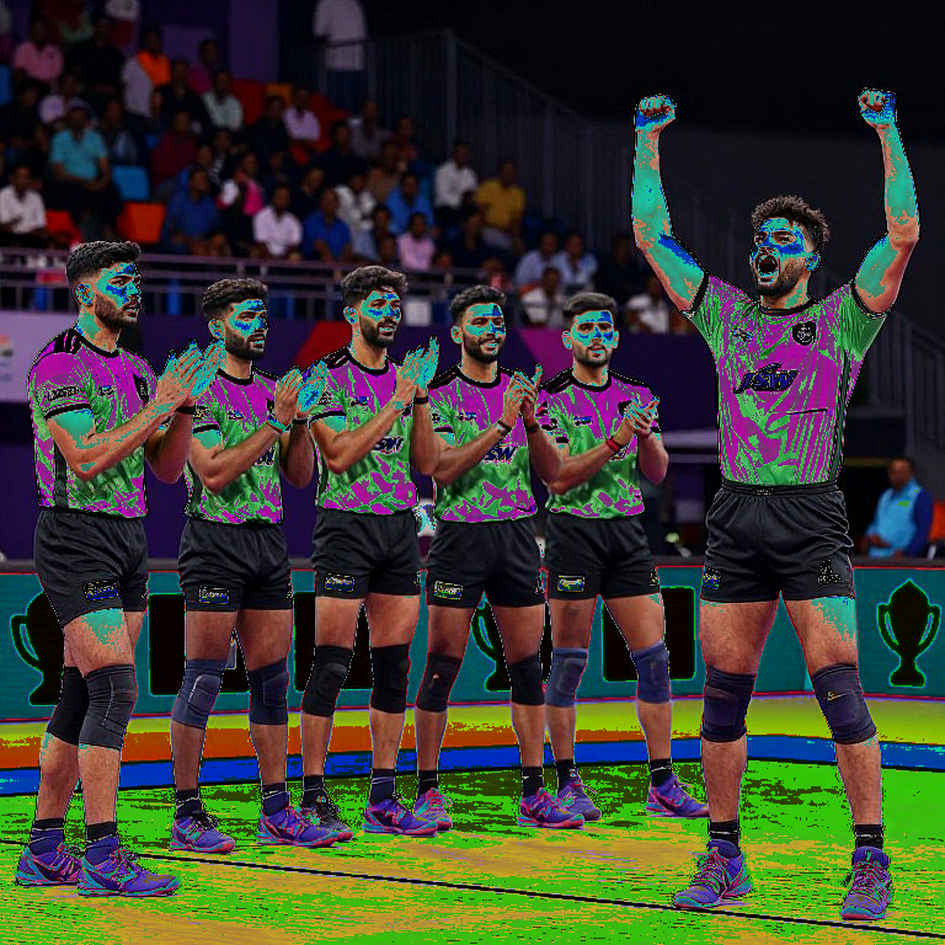
After two consecutive empty raids, the third becomes do-or-die: fail to score and the raider himself is out. That rule forces defensive teams to take risks. Three or more points in a single raid is a super raid; a tackle completed with three or fewer defenders on court is a super tackle, worth two.
None of this appears in the report. That is the first signal that the document in my hands came from a results feed, not from the mat.
The Table's Maths Checks Out — and That Is the Biggest News
First, the work nobody does: reverse-engineer the ranking logic from the scores.
Group A: Sri Lanka 48-21 (+27), India 46-26 (+20), Uganda 45-29 (+16). Group B: Scotland 59-30 (+29), Kenya 48-28 (+20). In all three cases the order follows the margin exactly. The tournament runs on the standard rule — points for a win, score difference as tiebreak. The factual layer of the report is reliable and arithmetically verifiable. That is not a small thing; on this beat, half the copy filed does not survive addition.
But reliable arithmetic and useful information are different things. The report contains no qualification rules — how many teams advance, what the semifinal structure is, nothing. Without that, the strategic value of score difference cannot be assessed. This is the report's largest gap, and it is a confirmed absence, not an inference.
Day-1 match totals were 69, 72, 74, 89 and 76. Scotland-Australia's 89 is the outlier, consistent with weak structured defence on both sides. But the report carries no tackle count and no raid-success percentage. Directional judgement only.
Absence Gets a Ranking
The table's real flaw is not a wrong number. It is the structure. A score-difference rule mechanically ensures that a team which has not played ranks above a team which played and lost. Nigeria is fourth in Group A without a single raid. Bangladesh is third and Canada fourth in Group B, both unplayed.
This is not the report's error; it is the table's machinery. But the consequence for the reader is that Day-1 standings carry almost no predictive value. And in Group B it is starker still — Bangladesh, sitting third, is in all likelihood the strongest side in that group. It has not played, so its difference is zero, so it sits below Scotland (+29) and Kenya (+20). A team that did nothing ranks below a team that beat Australia 59-30.
The report twice notes that "the table could change at any time." True as fact. Inadequate as analysis. The point is not that the table will change — the point is that what it shows now is a calendar, not a competition.
Seven Against Six: The Format Rewards Blowouts
Group A has seven teams, Group B six. A full round-robin gives Group A six matches each and Group B five. Two problems follow.
First, unequal match counts make cross-group score-difference comparison even weaker than it already is.
Second, and more important — the incentive to run up a margin is sharper in the smaller group. In five matches, one blowout can decide top spot. Scotland's 59-30 may be exactly that arithmetic at work. For a strong side, the rational strategy is not to manage minutes but to maximise the margin against a weak opponent. When the format itself pays for blowouts, 59-30 and 48-21 are not surprises. They are expectations.
That has a direct cost: competitive credibility. In an event where the most efficient route to winning is crushing a weak team, the spectator has no basis for telling who is genuinely good and who merely has a good calendar.
Lovepreet Brar's 23: A Number Built by the Opposition
Only one player is named in the entire report — Lovepreet Brar, Scotland, 23 raid points in a 59-30 win.
The maths: 23 of 59 is at least 39 per cent of the team total. Since a team's score also includes tackle, bonus and all-out points, his share of the team's raid points is likely above 50 per cent. Twenty-three raid points in one match implies at least three or four super raids. An excellent individual performance.
But stop there. Those 23 points came against Australia — the worst defence of Day 1, a side that conceded 59. A single sample against the weakest defence in the group is not evidence of a sustainable level. In Pro Kabaddi analytics, one match sits well inside the noise band; a raider's true level needs eight to ten matches or a full season.
So calling Lovepreet Brar this tournament's breakout star would be premature. The number says more about the tournament's thin depth than about the player's mastery.
A second signal hides in the same number, and it is a warning. Scotland's attack is concentrated in one raider. Such a side folds quickly against disciplined chain-tackle defence — India, Bangladesh and Sri Lanka all know how to neutralise a single raider. Dependence on one player is not a good story. It is a structural vulnerability.
The Name Contains a Rules Question
"Lovepreet Brar" is a Punjabi name. Scotland's kabaddi ecosystem runs overwhelmingly on the British Punjabi diaspora. And diaspora kabaddi is culturally rooted in Circle Style — circular field, one-on-one attack and defence, the rural Punjabi form.
A player raised in that tradition must adapt to Standard Style's 7v7 positional defence, bonus line and thirty-second cant discipline. That adaptation gap is the most under-reported story in diaspora kabaddi, and it plausibly explains the 89-point total in Scotland-Australia — loose structured defence on both sides.
Which raises a question the report never answers: which rule set is this tournament using, Standard or Circle? Scotland, England, Canada and Australia all draw on the same diaspora tradition rooted in Circle Style. If officiating standards are hybrid or inconsistent, every technical reading shifts. Low probability, but not dismissible — because the report never states the variant at all.
Two African Wins, Dismissed in a Single Line
Kenya beat Singapore 48-28. Uganda beat Malaysia 45-29. Same day, two comfortable African wins over Asian opposition.
In the standard "internationalisation" narrative, African teams are participants, not competitors. Two wins shake that narrative — but only shake it. One match each, no statistics, no tackle data. The correct conclusion is "worth tracking," not "power shift." The reporter who builds a star from one match builds a revolution from one match. Both are wrong.
India's 46-26 Cannot Be Read
India beat England 46-26. A twenty-point margin is solid but unremarkable by Indian standards — Sri Lanka's margin (+27) was larger.
And here the report's central failure surfaces: which India was this? Senior national side, or a development/domestic squad? Nowhere stated. Without it, 46-26 supports no conclusion at all. It is no coincidence that not a single Indian player is named or statistically quoted anywhere in the report — when the host team's match should have been the centre of the coverage. That editorial choice is itself a signal: the report was compiled from a score sheet, not from the floor.
Beyond the Scoreboard: What the Frame Hides
Now the most important point about this event, and the one nobody in the press box wrote.
"Commonwealth" is not a neutral adjective. It is a structural filter.
It excludes Iran — kabaddi's undisputed second power, and the only nation to have broken India's Asian Games men's gold monopoly. Iran is not a Commonwealth member, so Iran is not here. It also excludes South Korea, which has risen systematically over the past decade.
The result is a thirteen-team event played without the second-best team in the world. In a tournament missing the number two, the title "international championship" is a geographic condition, not a competitive claim.
And one more line, repeated in every kabaddi report and wrong every time: kabaddi is not India's national game. The 2026 RTI reply confirmed India has no officially declared national sport. Kabaddi is the country's flagship indigenous sport — that is the accurate sentence. The most checkable fact in this sport is the one everybody repeats without checking.
Likewise, kabaddi is not on the Commonwealth Games programme. "Commonwealth" here is a membership label, not an institutional sanction.
Before the Last Raid: The Table Is Sheet Music, Not the Song
The most honest sentence available after Day 1: this table decides nothing about anybody's strength. Thirteen teams, five matches, one name, zero statistics. What is available stops at the score; what is decisive — qualification rules, India's squad composition, the rule variant, raid-success rates, tackle counts — is all missing.
When I recorded forty minutes of empty-arena ambience inside the Bengaluru bubble during Season 8 in 2026 — no cant, no counting, no roar on an all out — I thought emptiness was the loudest signal available. The Ahmedabad sheet teaches the same lesson. Nigeria's fourth place is not showing strength. It is showing that Nigeria has not started.
Where to look next? Bangladesh's first match. If they beat Scotland, Group B's table turns over and the Day-1 ranking stands exposed as a calendar. And if the semifinal margins exceed twenty points, the question will not be who won — it will be whether the losing side was ever in a position to win at all.
Eleven weeks on the Titans bus taught me to count the odometer before trusting the scoreline. In Ahmedabad the odometer has only just started. The team sitting fourth without playing could be third tomorrow, or seventh. The table is sheet music. The song has not played yet.